If you raised your Seed round in 2024 or 2025, you remember the pitch deck advice: “Show us the vision. Show us the TAM”.
Welcome to 2026. The game has changed.
The “Growth at All Costs” era is officially dead, buried alongside the zero-interest rate phenomenon. Today, if you walk into a Series A meeting with a hockey-stick growth chart but a Burn Multiple of 3.5x, you will be laughed out of the room.
Investors in 2026 have a new obsession: Efficient Growth. They don’t just want to know if you can get to $1M ARR (Annual Recurring Revenue); they want to know how much cash you will burn to get there.
This shift has created a dangerous trap for early-stage founders. You need to grow fast enough to prove product-market fit, but you can’t afford the bloated headcount that traditionally fuels that growth.
So, how do you solve this paradox? How do you scale sales velocity without scaling burn?
The answer lies in a strategy we call “The Rapid Deployment Model”.
This is not just about outsourcing; it’s the difference between building a standing army from scratch versus deploying an elite special ops team tomorrow.
In this guide, we are going to break down the math, the timelines, and the exact playbook for sprinting from $0 to $1M ARR in the 2026 efficiency economy.
Table of Contents
The “Valley of Death” Has Widened
The journey from Seed to Series A has always been precarious, but the metrics have tightened.
- 2021 Standard: $1M ARR, 200% Growth, Burn ignored.
- 2026 Standard: $1.5M ARR, 3x Growth, Burn Multiple < 1.5x.
Your Burn Multiple (Net Burn / Net New ARR) is the North Star. If you burn $2M to generate $1M in new ARR, your multiple is 2.0x. In this market, that is considered “suspect”. If you burn $1M to get $1M (1.0x), you are elite.
The biggest killer of your Burn Multiple? Idle Headcount.
Specifically, sales hires who are ramping up, not closing.
The Old Playbook: The “Internal Hire” Trap
Let’s look at the traditional path founders take immediately after raising a Seed round. You have $3M in the bank, so you decide to “build the core team.”
You aim to hire 2 SDRs (Sales Development Reps) and 1 AE (Account Executive).
The Timeline of Pain (Internal Hiring)
Here is the realistic timeline for an internal hire in 2026, based on aggregated SaaS data:
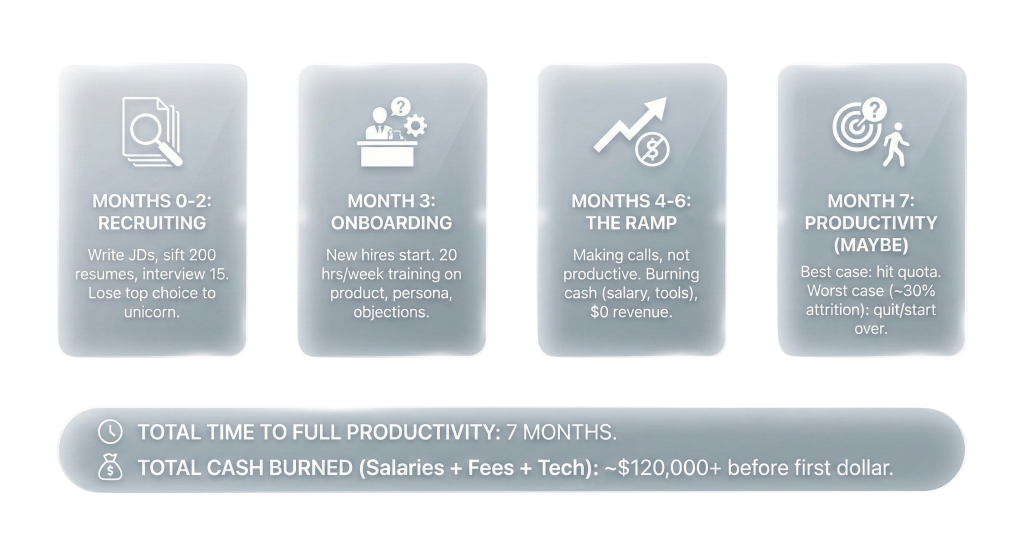
For a Seed stage company, losing 7 months is more than a delay; it’s an existential threat. You have burned nearly a year of runway just preparing to sell.
Rapid Deployment via Specialized Partners
In 2026, agility is the ultimate currency. The “Rapid Deployment” playbook rejects the premise that you must own the headcount to own the result.
Instead of hiring permanent staff for a temporary validation phase, you utilize Staff Augmentation, specifically high-level, embedded sales talent, to validate your GTM (Go-to-Market) motion immediately.
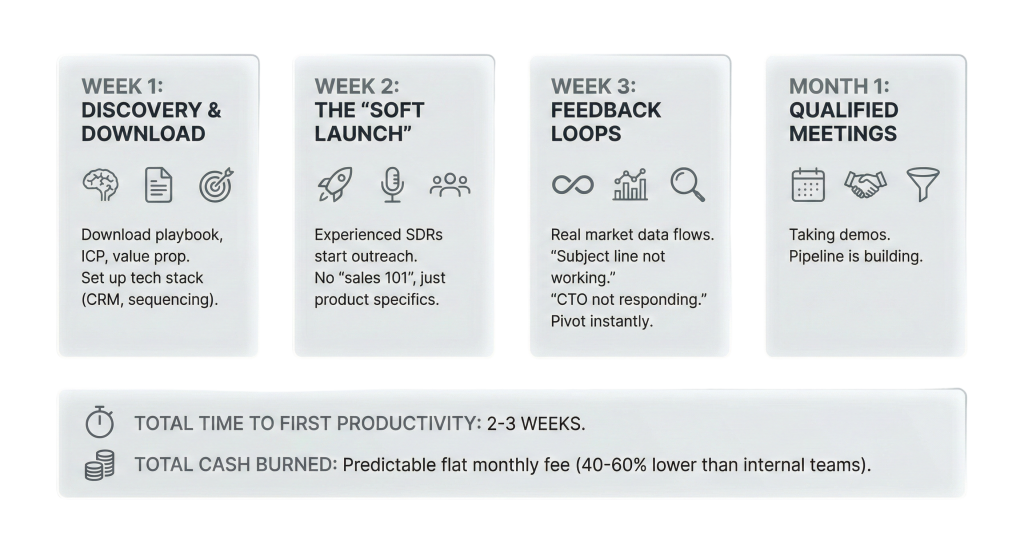
The Timeline of Velocity (Partnered Model)
Here is what happens when you plug in a specialized partner like Techsho:
Internal vs. Techsho
Let’s look at the numbers. We’ll assume a standard Seed Stage scenario: targeting $1M ARR, needing to generate $80k in Monthly Recurring Revenue (MRR) momentum.
| Metric | Option A: Internal Team (2 SDRs) | Option B: Techsho (Sales Pod) |
| Recruitment Cost | $20,000 (Agency fees or Founder time) | Flat monthly fee per team member |
| Time to First Dial | 90 Days (Hiring + Setup) | 14 Days |
| Management Overhead | High (Founder manages daily) | Low (Partner manages performance) |
| Tech Stack Costs | ~$500/mo per seat (Salesforce, Outreach, ZoomInfo) | Included (Often bundled in service) |
| Flexibility | Rigid (Firing is hard/costly) | Elastic (Scale up/down monthly) |
| Risk Profile | High (Bad hire kills 6 months) | Low (Swap rep if underperforming) |
| Burn Multiple Impact | Negative (High upfront cost, delayed return) | Positive (Revenue aligns with cost quickly) |
Opportunity Cost
The most expensive line item isn’t on the spreadsheet. It’s Founder Attention.
Every hour you spend reviewing SDR resumes is an hour you are not spending on Product Strategy or Investor Relations. In the Rapid Deployment model, you buy back your own time. You transition from “Sales Manager” to “VP of Closing.” Your job becomes taking the qualified meetings your partner generates, not nagging reps to update the CRM.
Why Investors Love This Hack in 2026
You might worry: “But don’t investors want to see that I can build a team?”
Yes, eventually. But at the Seed stage, they value Capital Efficiency and Data Validation more.
When you use a partner like Techsho to get from $0 to $1M, you present a very different story at your Series A pitch:


Let’s say…
Let’s say you are selling a DevTool.
- Month 1: You hypothesize your target is the CTO.
- Month 2: Your Techsho SDRs blast the CTO market. 0% conversion.
- Month 3: We pivot to Product Managers. 15% conversion.
If you had hired internal reps, you would have hired “technical sales reps” specifically for CTOs. When the pivot happened, you might have had the wrong people. You would have to fire and re-hire.
With Techsho, we have the bandwidth to adapt everything according to performance, from team to messaging.
3 Steps to Execute “Rapid Deployment”
If you are ready to prioritize Accelerated Growth over headcount vanity metrics, here is your action plan:
1. Define the Minimum Viable Segment
Don’t ask an external partner to “sell everything to everyone.” Give them a spearhead.
- Bad: “Call tech companies”
- Good: “Call VP of Operations at Logistics SaaS companies with 50-200 employees in the Midwest”. Narrow focus equals faster data.
2. Establish Flash Reporting
Don’t wait for monthly QBRs. In the 0 to $1M phase, you need weekly (or daily) feedback loops.
Demand a Slack channel where your partner drops call recordings of rejections.
- Insight: “They love the features but hate the setup fee”
- Action: Change the pricing model tomorrow.
3. The “Graduation” Plan
The goal isn’t to outsource forever. The goal is to outsource until it hurts not to own it.
Once a channel (e.g., LinkedIn Outbound) is generating predictable ROI for 3 consecutive months, then you hire an internal manager to take it over.
A good partner helps you transition. They hand over the playbooks, the scripts, and the data.
Conclusion: Velocity Wins
In 2026, the winner isn’t the founder with the biggest office or the most employees on LinkedIn.
The winner is the founder who gets to the truth fastest.
The truth about your market, your pricing, and your messaging is out there. You can spend 6 months building a boat to go find it, or you can rent a speedboat and be there by Friday.
From Seed to Series A, speed is safety.
Ready to Deploy?
At Techsho, we specialize in the Rapid Deployment model for B2B SaaS. We act as your interim RevOps engine, validating your market and filling your calendar while preserving your runway.
- 2-Week Launch: No recruiting delays.
- Reliable, dedicated team: We handle your outbound sales motion with full transparency.
- Founder-Focused: We give you your time back.